First – if you haven’t downloaded Finger Free
on the Apple App Store – GET IT here >
If you bite your nails, bite your cuticles, tear hangnails, rip the skin around your fingernails, or pick at rough edges until your fingers hurt, you already know something the average health article usually misses.
This is not some cute little “bad habit.”
For a lot of people, finger nail biting is a private cycle of tension, relief, damage, shame, and repetition. It can start in childhood and follow a person into college, work, marriage, parenting, middle age, and beyond. It can wreck thumbnails for years. It can leave 8 out of 10 nails damaged at the same time. It can make a person hide their hands without even realizing they are doing it.
And a lot of the time, it is not just nail biting.
It is biting the cuticle.
It is biting skin around nails.
It is ripping hangnails.
It is pulling dry skin from the sides of the nails.
It is feeling one rough keratin edge and suddenly not being able to think about anything else until that edge is gone. Then after it is gone, there is more damage, more roughness, and more to attack.
That is one reason people often search for help using a phrase like nail biting, even when what they are really doing all day is cuticle picking, skin picking around nails, biting skin at nails, or tearing at the tissue around the nail folds.
Join the FingerFree App Early Access List
Lock in the lowest price before launch.
These finger nail biting case studies were created to reflect realistic patterns seen again and again in adults who struggle with nail biting, cuticle biting, and finger skin picking. They are not lazy generic summaries. They are detailed, human-style stories built around the exact kinds of triggers, damage patterns, emotions, routines, and failed stop attempts that show up in real life.
Across these 10 stories, you will see patterns that repeat hard:
- stress and anxiety
- boredom and waiting
- driving and watching TV
- studying and screen time
- rough cuticles and keratin edges
- perfectionism and texture sensitivity
- private shame and hidden hands
- temporary improvement during long busy work shifts
- relapse the second life opens up again
You will also see something else that matters a lot
Many people do not bite all ten nails equally.
Some go after both thumbs constantly. Some destroy index fingers. Some barely chew the nail plate anymore and now focus almost entirely on the cuticle and skin around the nails.
Some have one or two “safe” nails and 8 out of 10 damaged ones.
Some only stop when their schedule gets brutally busy and they lose the free time and privacy that allow the habit to run.
That level of specificity matters. Because the more clearly a person sees their own pattern, the easier it becomes to stop treating this like random weakness and start seeing it as a repeatable loop.
Below are 10 realistic finger nail biting case studies that show how this habit actually behaves in adult life.
What these Finger Nail Biting Case Studies Reveal
When you line these stories up next to each other, some clear themes come out fast.
First, a lot of people are not only responding to emotion. They are responding to texture. A rough cuticle, a lifted bit of skin, a peeling hangnail, or one sharp corner on the nail can act like a trigger all by itself. The person notices it, touches it, picks at it, bites it, and ends up creating new damage that becomes the next trigger.
Second, long periods of busyness often reduce the behavior. That came up again and again. When someone is working 12-hour shifts, constantly around people, physically busy, and exhausted by the time they get home, the habit often drops. Not because the person is “cured,” but because the environment no longer gives the habit what it likes most
- idle hands
- privacy
- half-attention
- downtime
- repetitive low-focus moments
Third, shame becomes part of the cycle. People hide their hands. Curl their fingers inward. Avoid manicures. Avoid close-up photos. Feel embarrassed on dates, at work, in meetings, while handing someone a card, while reaching across a table, while typing next to another person. That constant low-level humiliation matters. It turns a physical habit into an identity problem.
Fourth, many people searching for nail biting help are really describing a broader body-focused repetitive behavior around the nails. They may use the term nail biting because that is the closest label they know, but their actual daily problem might be
- biting my cuticle
- ripping skin around fingernails
- pulling skin at the side of the nails
- chewing hangnails
- picking dry keratin around the nail folds
- damaging the skin until it burns, swells, or throbs
That difference matters because broad health sites often flatten all of this into one vague problem. Real people do not experience it vaguely. They experience it finger by finger.
The 10 Case Studies
Finger Nail Biting Case Study #1 – Melissa
Melissa is 48 and has been biting and picking at her nails since childhood. Her case shows what happens when chronic nail biting becomes part of adult identity. She affects 8 out of 10 nails, hides her hands, notices other women’s healthy nails constantly, and feels both relief and shame every time she bites or picks.
Main patterns
- stress, waiting, TV, phone use, rough cuticles
- 8 out of 10 nails affected
- major damage to self-esteem and confidence
Read the full case study
Melissa’s Finger Nail Biting Case Study #1
Finger Nail Biting Case Study #2 – Darren
Darren is 51 and his case is heavily focused on torn cuticles, ripped hangnails, and bleeding thumbs. He does not only bite nails. He attacks the skin around them. His story is a strong example of what happens when nail biting disorder becomes more about skin damage than the nail plate itself.
Main patterns
- driving, stress, invoices, anger, rough skin around nails
- thumbs and index fingers hit hardest
- brief relief followed by frustration and anger
Read the full case study
Darren’s Finger Nail Biting Case Study #2
Finger Nail Biting Case Study #3 – Elina
Elina is 34 and works on screens and Zoom calls all day. Her case shows how nail biting can merge with cuticle biting, hangnail ripping, sensory irritation, and visual scanning. A tiny rough edge becomes mentally huge for her, and the shame spills into dating, social life, and work.
Main patterns
- Zoom calls, screen work, stress, rough cuticles, hangnails
- biting skin around nails more than just the nail itself
- strong mix of anxiety, perfectionism, and shame
Read the full case study
Elina’s Finger Nail Biting Case Study #3
Finger Nail Biting Case Study #4 – Wade
Wade is 43 and gives a simpler, more blunt version of the same hell. Lifelong nail biting. Chewed thumbs. Damaged cuticles. Constant low-level tension. He does not describe huge emotional drama, but the habit is deeply wired and clearly affecting how he sees himself.
Main patterns
- boredom, waiting, driving, work stress, cold weather
- thumbs and index fingers as target fingers
- long-term habit that feels hardwired
Read the full case study
Wade’s Finger Nail Biting Case Study #4
Finger Nail Biting Case Study #5 – Noor
Noor is 29 and knows the word onychophagia, but that knowledge has not stopped anything. She works in healthcare and feels extra pressure to look neat and composed while privately fighting cuticle biting, rough keratin triggers, and swollen sore fingertips.
Main patterns
- work pressure, perfectionism, rough cuticles, sensory irritation
- 8 out of 10 nails affected
- strong workplace shame and hidden hand behavior
Read the full case study
Noor’s Finger Nail Biting Case Study #5
Finger Nail Biting Case Study #6 – Jori
Jori is 22 and her case is tied hard to college life. Studying, deadlines, late nights, money stress, scrolling, waiting for texts, dry cuticles, and rough edges all feed the loop. Her fingers become a target for nervous energy and half-focused stress.
Main patterns
- studying, phone use, money stress, dry skin, coffee jitters
- 9 out of 10 nails affected
- social embarrassment plus identity damage at a young age
Read the full case study
Jori’s Finger Nail Biting Case Study #6
Finger Nail Biting Case Study #7 – Miriam
Miriam is 46 and her case is more cuticle-focused than classic nail-focused. She pulls dry keratin ridges, tears side skin, and picks rough cuticle edges while working at a desk. Her story is a great example of office-life finger damage that looks small from the outside but feels constant from the inside.
Main patterns
- spreadsheets, hold music, work stress, dry skin, rough cuticles
- skin around nails targeted more than the nail plate
- chronic half-healed fingertips and hidden hands at work
Read the full case study
Miriam Finger Nail Biting Case Study #7
Finger Nail Biting Case Study #8 – Brock
Brock is 38 and is much more of a skin biter around the nails than a standard nail biter now. He scans for rough edges, rubs the area, locates a hangnail or torn cuticle, and then starts ripping. Meetings, boredom, videos, and waiting all feed the cycle.
Main patterns
- boredom, meetings, driving, rough skin, ADHD-type restlessness
- skin around fingernails more damaged than the nails
- the search phase comes before the bite phase
Read the full case study
Brock’s Finger Nail Biting Case Study #8
Finger Nail Biting Case Study #9 – Sable
Sable is 41 and works in a beauty-related profession, which makes the hand shame even worse. Her case includes nail bed pain, cuticle destruction, emotional overload, and the feeling that her fingers expose private chaos in a job where hands are part of the presentation.
Main patterns
- emotional overload, loneliness, rough edges, being alone after work
- both nail biting and skin biting around nails
- strong impact on confidence, femininity, and work identity
Read the full case study
Sable’s Finger Nail Biting Case Study #9
Finger Nail Biting Case Study #10 – Sam
Sam is 57 and shows what lifelong nail chewing can look like after decades. His thumbnails are repeat targets. The habit feels automatic, old, and tied to stress, waiting, and irritation. His case matters because a lot of older adults quietly assume it is too late to change.
Main patterns
- waiting, TV, rough thumbnail edges, work pressure
- thumbnails as the main target
- decades of habit turning into identity
Read the full case study
Sam’s Finger Nail Biting Case Study #10
Common Triggers Across All Cases
When people talk about nail biting, they often talk about stress first. Fair enough. Stress is huge. But these stories show that stress is only one layer.
A massive trigger across all 10 case studies is roughness.
- One rough cuticle edge.
- One sharp nail corner.
- One lifted piece of skin.
- One hangnail.
- One dry keratin ridge around the nail.
That tiny physical cue can trigger a whole chain reaction. The person touches it to check it. Rubs it with the opposite thumb. Hooks a nail under it. Bites it. Pulls it. Then makes the area worse. Then notices the new roughness. Then goes back in again.
That means a lot of people are not just responding to emotion. They are responding to texture plus emotion.
Another major trigger is waiting.
- Waiting in traffic.
- Waiting on hold.
- Waiting for emails.
- Waiting for a page to load.
- Waiting for a text back.
- Waiting through a show.
- Waiting during a meeting.
Waiting creates that dangerous state where the mind is active but the hands are underused. That is perfect territory for finger nail biting, cuticle chewing, and picking skin around nails.
Then there is screen time.
Phones and laptops create endless half-focused moments. You are engaged enough to stay put, but not physically occupied enough to stop your hands from roaming. That is why studying, Zoom calls, scrolling, watching videos, and late-night phone use show up so often in these stories.
Driving also comes up again and again. One hand is free. Stress is present. Waiting is built in. Privacy is built in. You can chew a thumb cuticle in traffic without anybody saying a word.
Then there is emotional overload.
Not always panic. Sometimes just background tension. A low hum of stress. Irritability. fatigue. frustration. loneliness. perfectionism. anger. pressure. The fingers become a place where that pressure gets dumped.
And then the hidden killer shows up
Shame!
The person bites or picks because they are stressed or triggered. Then the damage itself creates embarrassment. The embarrassment creates more tension. More hiding. More self-monitoring. More self-disgust. That shame becomes part of the engine.
The Difference Between Nail Biting, Cuticle Biting, and Skin Picking Around Nails
A lot of people use one label for all of this and that label is usually nail biting. But these are not always the same behavior.
Nail biting usually means chewing the nail plate itself. The nail gets shortened, uneven, ragged, or bitten low enough to feel exposed.
Cuticle biting means the person focuses on the tissue around the base of the nail. They may chew the cuticle itself, tear the edges, or keep biting at raised bits of skin.
Skin picking around nails often includes sidewall tearing, ripping hangnails, pulling skin from the corners, and repeatedly damaging the tissue beside the nail. Some people use their teeth. Some use their nails. Some do both.
A person may start as a nail biter and gradually become more of a cuticle picker or skin biter around the nails. That showed up repeatedly in the case studies above. The nail plate may not even be the main target anymore. The surrounding skin becomes the main battlefield.
That matters for two reasons.
First, the trigger changes. Rough skin around nails can become more important than the nail itself.
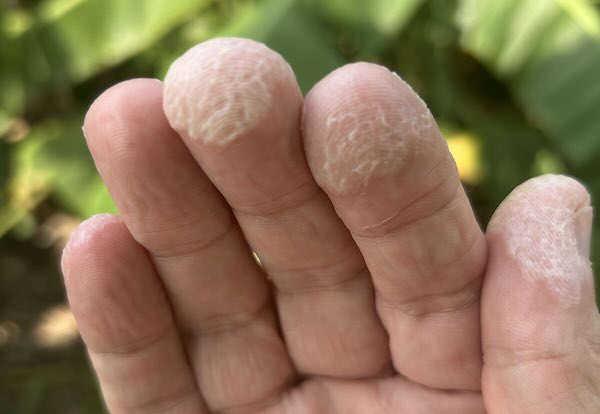
Second, the damage changes. Instead of only short nails, the person may end up with swollen fingertips, torn side skin, shiny red cuticles, sore nail folds, and hands that look like they are always half-healed.
If you have been searching for terms like these, you are not alone
- biting my cuticle
- biting skin around nails
- ripping skin near fingernails
- tearing hangnails with teeth
- why do i chew the skin around my nails
- why are my cuticles always damaged
- finger skin picking near nails
- nail biting and cuticle picking together
- rough keratin around nails
- swollen fingertips from biting skin
A lot of people are dealing with exactly that.
Why Many People Only Stop when Life is Very Busy
This showed up so many times across the stories that it deserves its own section.
A lot of chronic nail biters and cuticle pickers report one weird thing
They improved the most when life got insanely busy.
- Long shifts.
- Public-facing work.
- Physical labor.
- No privacy.
- No idle time.
- No energy left at home.
At first glance that sounds strange. You would think more stress would mean more biting. But the full picture is different.
The habit does not only need stress. It also needs opportunity.
- It needs a free hand.
- It needs time to scan.
- It needs rough skin or a nail edge to notice.
- It needs privacy or at least invisibility.
- It needs those low-focus moments where the person can drift into the behavior.
When a schedule gets brutally full, a lot of that disappears. The urge may still exist, but the habit has fewer openings.
This matters because it tells us something important
The problem is not just emotion.
The problem is emotion plus access plus opportunity plus sensory trigger.
That is a much more useful model than simply telling someone to “reduce stress.”
What To Do If You Relate to these Cases
If these case studies feel uncomfortably familiar, that is probably because your problem is more real and more patterned than people around you realize.
That is actually good news.
Why
- Because patterns can be studied.
- Patterns can be interrupted.
- Patterns can be redesigned.
The first step is getting brutally honest about your exact loop.
Ask yourself
- Which fingers do I target most
- Is it the nail, the cuticle, or the skin around the nail
- What rough textures trigger me
- What time of day is worst
- What environments are worst
- Do I bite more while driving, watching TV, studying, scrolling, waiting, or lying in bed
- Do I improve when I am busy and around people
- What emotion usually comes first
- What emotion comes right after
That kind of clarity matters more than generic motivation.
The next step is building interruption earlier in the loop. Not after the finger is already bleeding. Earlier. During the scan. During the rub. During the “I’m just fixing this one tiny edge” lie your brain tells you right before the damage starts.
Then you need replacement actions that are actually realistic, not fluffy nonsense. They have to fit the exact trigger environment. What works for driving may not work for studying. What works during a Zoom call may not work when lying in bed.
And finally, you need to stop treating this like a moral failure. It is not helping. Shame is fuel for the loop.
If these stories sound like you, start here
- learn your trigger pattern
- identify your target fingers
- notice whether rough cuticles or keratin edges start the loop
- pay attention to boredom, waiting, screen time, and driving
- build interruption before the damage phase
- stop pretending this is too small to matter
Because if it affects your hands every day, your confidence every day, and your stress every day, then no, it is not small.
It matters.
If you haven’t downloaded Finger Free
on the Apple App Store – GET IT here >
A Balanced Perspective
Nail biting affects people differently.
Read:
- When Nail Biting Is Not a Big Deal — And When It Is
- How to Stop Caring So Much About Nail Biting
Related Articles & Support
- How to Stop Biting Your Cuticles
- Why I Bite the Skin Around My Nails
- Nail Biting While Driving and Watching TV
- Rough Keratin Edges and Finger Picking
- Swollen Fingertips and Damaged Cuticles
- Onychophagia vs Onychotillomania
- Finger Biting Trigger Checklist
- How FingerFree.app Helps Interrupt the Pattern
- Is this a Mental Disorder?
- Can I Cause Permanent Damage?
Final Thoughts
The biggest lie about nail biting is that it is trivial.
- It is not trivial when your thumbs hurt.
- It is not trivial when 8 out of 10 nails are damaged.
- It is not trivial when you hide your hands every day.
- It is not trivial when your child starts copying it.
- It is not trivial when you are 30 or 57 and still fighting the same damn loop you had as a kid.
It’s time to do something about it.
These finger nail biting case studies show one thing clearly
People are not weak.
They are patterned.
And patterns can be broken.
Join the FingerFree App Early Access List
Lock in the lowest price before launch.